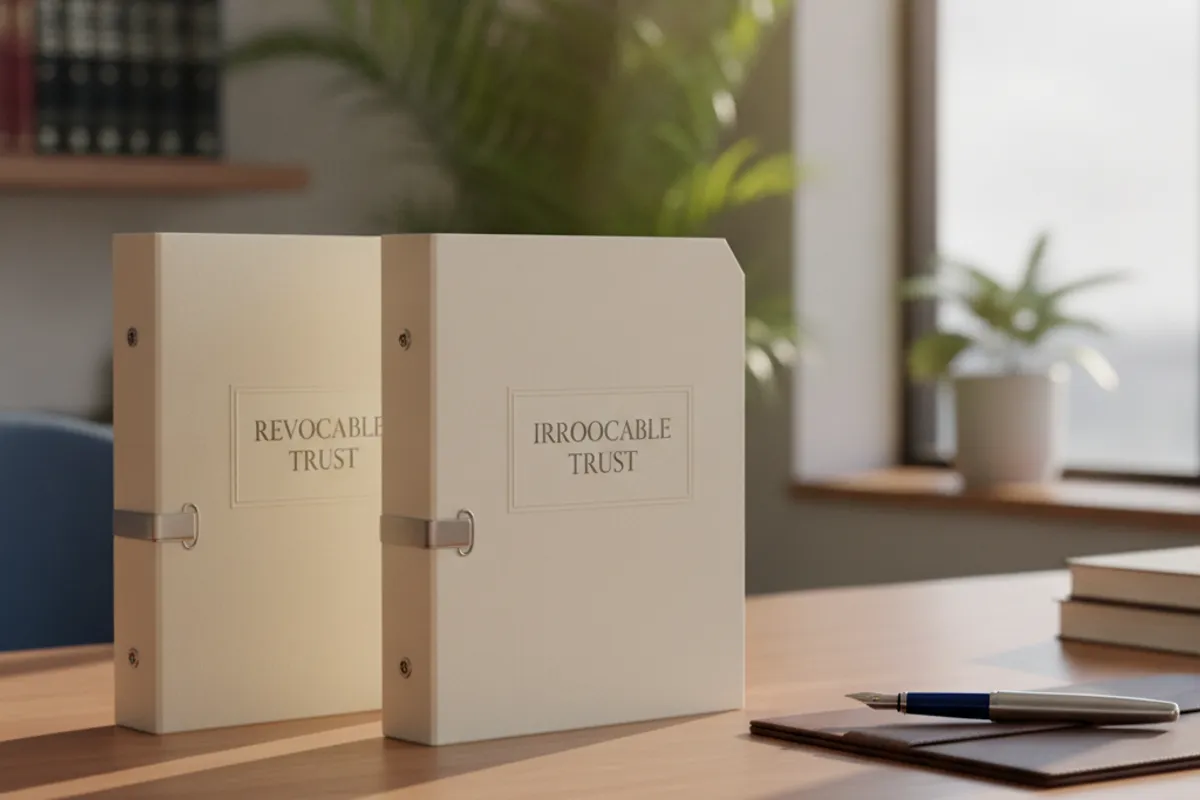
The core difference is control
A revocable trust lets you change, amend, or cancel it at any time during your lifetime. You retain full control of the assets inside it. An irrevocable trust, once established, generally cannot be changed or revoked without court approval or the consent of all beneficiaries. You give up control of the assets in exchange for specific legal benefits.
That trade-off is the defining difference. Everything else flows from it.
Revocable living trusts
A revocable living trust is the standard estate planning trust used by the majority of California homeowners. You sign the trust, transfer your assets into it, and serve as your own trustee while you are alive and competent. You can revoke it tomorrow if your circumstances change.
What it does:
- Avoids probate for assets held in the trust at your death
- Provides for incapacity management by a successor trustee without court intervention
- Controls the distribution of assets to named beneficiaries after your death
- Keeps the estate administration private, outside of public court records
What it does not do:
- Protect assets from your creditors during your lifetime (because you can revoke it, creditors can reach the assets)
- Reduce your taxable estate for federal estate tax purposes (assets are still considered yours)
- Qualify you for Medi-Cal benefits any faster than holding assets outright (because you have access to the funds)
For most San Diego County residents, a revocable trust is the right tool because the goal is probate avoidance and incapacity planning, not creditor protection or tax reduction.
See the revocable trusts service page for more on how the process works.
Irrevocable trusts
An irrevocable trust is a separate legal entity. Once you transfer assets into it, those assets are no longer yours in the legal sense. You generally cannot take them back, change the beneficiaries, or alter the terms without court involvement or unanimous beneficiary consent.
The loss of control is the price. The benefit is that the assets are no longer legally yours, which produces specific outcomes:
Creditor protection. Because the assets are not in your name, creditors generally cannot reach them (subject to fraudulent transfer rules, which require that the transfer not have been made specifically to defraud a known creditor). This is used by professionals with liability exposure and individuals in certain industries.
Estate tax reduction. Assets removed from your estate through an irrevocable trust reduce your taxable estate. For estates below the federal exemption (over $13 million per individual as of 2024), this is not a primary driver. For larger estates, it matters significantly.
Medi-Cal planning. California’s Medi-Cal program (Medicaid) looks back five years at asset transfers when determining eligibility for long-term care coverage. Assets in a properly structured irrevocable trust that was established more than five years before a Medi-Cal application may be excluded from the eligibility calculation. This is a planning strategy for people who anticipate needing nursing home care.
Special needs planning. A special needs trust is a specific type of irrevocable trust that holds assets for a beneficiary with a disability without disqualifying them from SSI or Medi-Cal benefits. Those government programs have income and asset limits. A properly structured special needs trust supplements government benefits without replacing them. See the special needs trusts page for more detail.
Charitable giving. Charitable remainder trusts and charitable lead trusts are irrevocable structures that accomplish estate tax, income tax, and philanthropy goals simultaneously.
Which one do most San Diego residents need?
The large majority of San Diego residents who need estate planning do not need an irrevocable trust. They need a revocable living trust with a pour-over will, a durable power of attorney, and an advance health directive. That set handles probate avoidance, incapacity planning, and asset distribution for the overwhelming majority of estates.
Irrevocable trust planning becomes relevant when one or more of these factors applies:
- Your estate is large enough that estate taxes are a consideration (above the federal exemption)
- You are planning ahead for potential long-term care costs and want to position assets for future Medi-Cal eligibility
- You have a family member with a disability who receives government benefits and you want to leave them assets without disrupting those benefits
- You have significant creditor exposure and want asset protection planning
- You have a specific charitable giving goal that an irrevocable structure accomplishes more efficiently
If none of those apply, a revocable trust is likely all you need on the trust side of your plan.
Converting between the two
You cannot convert a revocable trust to an irrevocable trust mid-stream in a way that achieves the same legal results as an irrevocable trust created originally as such. If Medi-Cal planning or creditor protection is a goal, timing matters enormously. Moving assets into an irrevocable structure the year before you need Medi-Cal coverage, for example, does not satisfy the five-year lookback and may result in a penalty period for benefits.
Irrevocable trust planning needs to happen with a long time horizon in mind, well before the circumstances that motivate it become urgent.
The role of an attorney
A revocable living trust is a somewhat standardized document with well-established California templates and requirements. An experienced estate planning attorney can draft one efficiently.
An irrevocable trust is not standardized in the same way. The tax code, Medi-Cal rules, and creditor protection laws each have their own requirements, and the trust structure has to be built around the specific goal. Getting it wrong does not produce a document that sort of works. It produces a document that fails to achieve the intended benefit, or that actively creates a problem (like a tax event or a disqualifying Medi-Cal transfer).
The California State Bar at calbar.ca.gov can connect you with a licensed estate planning attorney in San Diego County who handles both revocable and irrevocable trust planning.
Trust Law SD connects San Diego County residents with local estate planning attorneys who can assess your situation and recommend the right structure. Call (858) 925-5546 to get matched. For background on the irrevocable trusts tools available, see the service page.
Can I be the trustee of my own irrevocable trust?
Generally, no. If you serve as the trustee of an irrevocable trust and retain significant control over the assets, the IRS and courts may treat the assets as still belonging to you, defeating the purpose. Some carefully structured arrangements allow the creator limited roles, but this requires specific legal guidance.
What happens to an irrevocable trust after I die?
The trust continues to exist and is administered according to its terms, just like a revocable trust. The successor trustee distributes assets or continues managing them for beneficiaries according to whatever the trust document specifies.
Is the trust public record?
Neither revocable nor irrevocable trusts are routinely filed with the court or made public record during your lifetime. A trust that becomes subject to court supervision (for example, if a beneficiary sues) may enter the public record through that proceeding, but the document itself is private. This is one of the advantages over a will, which enters the public record through probate.